Rowbarrows, Exford, Exmoor National Park
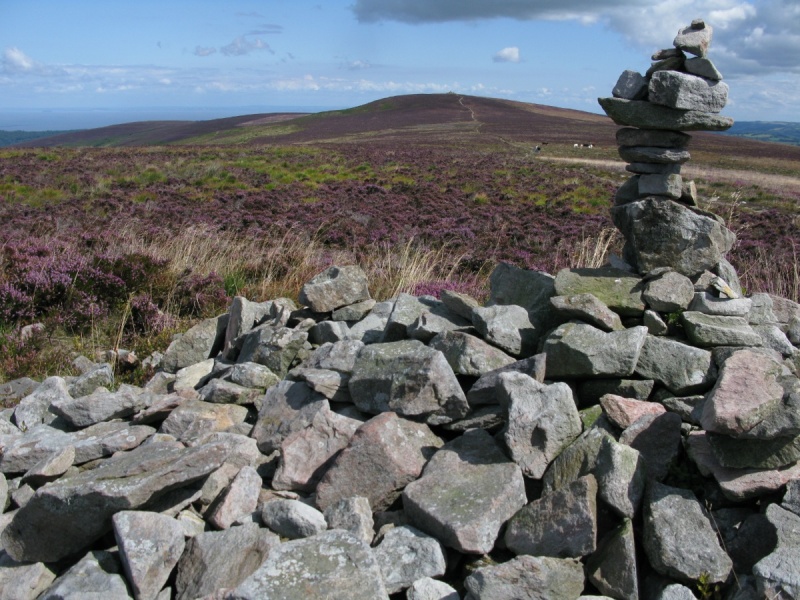
[Main photo: the view from Rowbarrows to Dunkery Beacon in summer]
Rowbarrows
A barrow is a prehistoric burial mound. There are hundreds of barrows on Exmoor. Great Rowbarrow and Little Rowbarrow are collectively referred to as the Rowbarrows and are situated close to Exmoor National Park’s highest ground at Dunkery Beacon on Dunkery Hill.
Visit for amazing views and great walking. The heather is extraordinary in summer.
Location of Rowbarrows
The Rowbarrows are located just west of Dunkery Beacon on the western side of Dunkery Hill.
Ordnance Survey Landranger shows Rowbarrows.
Ordnance Survey Explorer shows Great Rowbarrow and Little Rowbarrow.
We’ve positioned Rowbarrows on Google maps. Zoom in on the ‘Satellite’ setting to see their location.
Directions to, and parking at, Rowbarrows
Rowbarrows are located on Exmoor’s high moor. As such, you can approach from all directions. See our recommended route below.
Rowbarrows
Rowbarrows are 510 metres above sea level on Exmoor’s high moor near Dunkery Beacon. Dunkery Beacon is Exmoor National Park’s highest point at 519 metres above sea level. We’d recommend visiting both in one walk.
The Macmillan Way West runs across the high moor just south of Rowbarrows.
The summer heather is remarkable. For example, the heather in the main photo of this listing was taken in mid-August.
The high moor around Dunkery Beacon is part of the Dunkery and Horner Wood National Nature Reserve.
Rowbarrows, and nearby Dunkery Beacon, are on the edge of Holnicote Estate (National Trust).
Rowbarrow and Exmoor barrows
A barrow is a prehistoric burial mound. There are hundreds of barrows on Exmoor.
‘Dating. The chronology of Exmoor’s barrows is uncertain. A chronic lack of full scale, modern excavation means that none of the major barrows are securely dated. Neither do archaeologists understand for how long the barrows were used. Traditionally they are considered to date from c 2000 BC to 1500 BC (Todd 1987, 140), although recent work elsewhere in the country has shown that some originate in the Neolithic (Quinnell 1994a, 52). The truth is that the archaeological evidence to prove this on Exmoor does not exist. The closest modern dating evidence comes from an 8m diameter barrow on Bratton Down (just outside Exmoor National Park) excavated by Charles Whybrow in 1971 and this yielded a radiocarbon date with a range from the late 2nd to early 1st millennium BC (Quinnell 1997). Long barrows and henges, the archetypal Neolithic monuments found elsewhere in southern England, do not occur on Exmoor.’ (Source: ‘The Field Archaeology of Exmoor’ by Hazel Riley and Robert Wilson-North.)
Recommended route to Rowbarrows for the first time
To visit Dunkery Beacon for the first time, we’d recommend walking up from one of the parking areas on Dunkery Hill that line the road that cuts across the high moor to/from Porlock. These are marked on Ordnance Survey mapping and are visible on Google’s satellite imagery.
For example, there’s a small car park at Dunkery Gate and Dunkery Bridge just south east of Dunkery Beacon. It’s a short, sharp walk up top.
There’s another car park further north by the Macmillan Way West. Walk the track that crosses Dunkery Hill to Dunkery Beacon. Note that this track is pretty flat so it can be muddy after rainy spells.
Other routes and directions to Rowbarrows
Dunkery Beacon tops Dunkery Hill. You can access this high ground from all directions.
Routes and directions to Rowbarrows from the west
Follow the Macmillan Way West from the west to Dunkery Beacon.
Alternatively, wander across open access moor to the Rowbarrows (Great Rowbarrow and Little Rowbarrow) and then walk along the track that rises to Dunkery Beacon. This is superb in August when the heather is out.
Routes and directions to Rowbarrows from the east
Follow the Macmillan Way West from the east to Dunkery Beacon.
Alternatively, start from Wheddon Cross and walk the Coleridge Way to the edge of Dunkery Hill. A path marked on Ordnance Survey mapping leads to Dunkery Gate and Dunkery Bridge and then Dunkery Beacon.
Routes and directions to Rowbarrows from the north
This is a superb direction from which to approach Dunkery Beacon.
Start from Webber’s Post and then take one of the many paths that run from the Horner Wood area up to Dunkery Beacon. It’s a bit of a slog but the walking and views are amazing. The various paths are marked on Ordnance Survey mapping.
Routes and directions to Rowbarrows from the south
Exford is to the south east. Various paths marked on Ordnance Survey mapping run from the village to the open access land at Exford Common and Hoar Moor.
Connect with the Macmillan Way West to Dunkery Beacon. Alternatively, wander across open access moor to the Rowbarrows (Great Rowbarrow and Little Rowbarrow) and then walk along the track that rises to Dunkery Beacon. Again, this is superb in August when the heather is out.
The views from the Rowbarrows
Given its height above sea level, the views are sensational.
Highlights include:
Dunkery Beacon.
Dunkery and Horner Wood National Nature Reserve.
Porlock Bay.
Historical and cultural attractions near Rowbarrows
Allerford Museum West Somerset Rural Life Museum and Victorian School.
Further away, visit:
Minehead Harbour. Harbour in stunning location at the western end of Minehead Beach under North Hill. ‘There has been a harbour at Minehead since the late 1300s.’ (Source: Minehead Harbour website.)
Dunster Castle (National Trust). Impressive National Trust property dominating the beautiful village of Dunster.
Dunster Yarn Market, Butter Cross and Gallox Bridge (English Heritage). English Heritage properties in Dunster.
Cleeve Abbey (English Heritage). Wonderful English Heritage property just east of Exmoor National Park.
The Ancient Mariner Sculpture in Watchet. The Watchet and Quantock Hills National Landscape area inspired Samuel Taylor Coleridge to write ‘The Rime of the Ancient Mariner’.
Coleridge Cottage (National Trust). Visit the cottage in which Coleridge lived and wrote some of his most famous poetry. William Wordsworth lived, briefly, nearby.
Doone Valley/Doone Country. Richard Doddridge Blackmore's famous novel 'Lorna Doone' is set on Exmoor. Roughly speaking, Doone Valley/Doone Country runs south of Malmsmead and Oare along Badgworhty Water. It’s surrounded by high moor. Great walking.
Other attractions near Rowbarrows
Porlock Beach. Big rock and pebble beach at the western end of Porlock Bay.
Porlock Weir Harbour. Beautiful harbour with pub and hotel.
West Somerset Railway. Heritage railway running between Minehead and Bishops Lydeard.
Dunster Estate (The Crown Estate). Home to England’s tallest tree. Great for walks and views. Wander up to Conygar Tower.
Dunster Beach. Massive low tide sand and stone beach.
Selworthy Green (National Trust). 'There has been a village here since medieval times, but the current cottages were designed by Sir Thomas Dyke Acland in 1828 to create attractive homes for estate pensioners. Beyond the church (14th century), you'll find the village green, surrounded by warm yellow thatched cottages. Notice the tall chimneys which helped to draw the fire and carry sparks away from the thatch.' (Source: information board at Selworthy.)
Further away, visit:
Minehead Blenheim Gardens. Popular gardens behind the Esplanade and North Road at the western end of Minehead Beach.
Dunster Gardens, Dovecote and Tithe Barn. Gardens in the centre of Dunster village.
Dunster Castle (National Trust). The castle is surrounded by many gardens and heavily wooded walkways. The Keep Garden tops the hill on which the castle sits. Lawn’s Bridge, Marshall’s Bridge and Lovers’ Bridge span the River Avill on the eastern side of the castle.
Knightshayes (National Trust). Impressive gardens just off the A396 between Exmoor National Park and Tiverton.
Cothay Manor. Again, gardens outside the national park near Wellington and the M5.
Hestercombe House & Gardens. Gardens located just south of the Quantock Hills National Landscape near Taunton and the M5.
If you don’t mind the drive, RHS Garden Rosemoor by Great Torrington south west of Exmoor National Park is magnificent.
Places to eat and drink near Rowbarrows
There are pubs at Wheddon Cross (Rest & Be Thankful Inn), Exford (The White Horse Inn/The Crown Hotel) and Porlock ( for example The Royal Oak/The Ship Inn).
There are tea rooms at Horner (Horner Tea Gardens) and Porlock.
Villages and towns near Rowbarrows
Horner village. Another beautiful Exmoor village at the bottom of Horner Wood by Horner Water. Enjoy a cream tea at Horner Tea Gardens.
Luccombe. Village not far from the viewpoint and large car park at Webber’s Post with thatched cottages like those at Selworthy.
Selworthy village. One of the West Country’s prettiest villages, Selworthy is famous for its thatched cottages and village green. Enjoy a cream tea at the Periwinkle Tea Room.
Allerford village. Beautiful village further inland known for its packhorse bridge.
Bossington. Village by Bossington Beach below Bossington Hill.
Porlock. Famous West Country village in Porlock Vale.
Porlock Weir. Amazing coastal village with harbour, pub, hotel and beach.
Minehead. Popular West Country resort town with huge beach and harbour. The start/end of the South West Coast Path.
Dunster. Essential visiting. Beautiful village dominated by Dunster Castle (National Trust) with English Heritage properties, Dunster National Park Visitor Centre and plenty of shops and places to eat and drink. Park of Dunster Estate (Crown Estate) with England’s tallest tree and super walk and views.
Photo Gallery