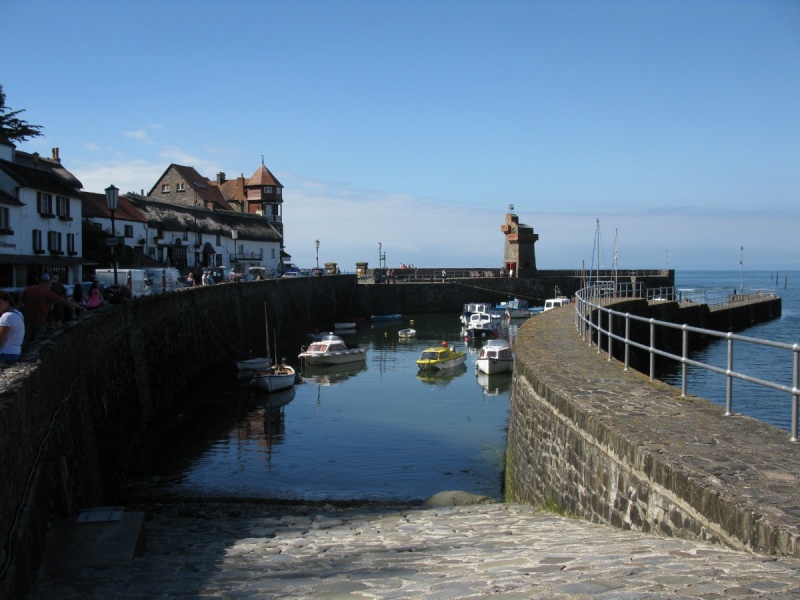
Lynmouth Harbour, Lynmouth, Exmoor National Park
[Main photo: Lynmouth Harbour viewed from Riverside Road]
Lynmouth Harbour
Beautiful habour by Lyn Mouth/the mouth of the River Lyn between Lynmouth Western Beach and Lynmouth Eastern Beach. Lynmouth Pavilion National Park Centre and Lynton and Lynmouth Cliff Railway are just west of the harbour. The Foreland rises to the east. You can take boat trips from the habour. The Two Moors Way starts/ends at the ‘The Walker’/Lynmouth Two Moors Way Statue nearby. There are pubs, shops (selling ice cream) and a takeaway fish and chips restaurant.
Location of Lynmouth Harbour
Lynmouth Harbour is located on the western side of Lyn Bay on the Exmoor coast.
We’ve positioned Lynmouth Harbour on Google maps. Zoom in on the ‘Satellite’ setting to see its location.
Directions to, and parking at, Lynmouth Harbour
Follow the A39 to Lynmouth.
There’s parking just off the A39 at Lyndale Cross Car Park or down on The Esplanade past Lynmouth Pavilion National Park Centre and Lynton and Lynmouth Cliff Railway. You can also park up in Lynton or even the beauty spot The Valley of Rocks and follow the South West Coast down to the harbour. It’s a beautiful walk. The cliffs here are very steep.
Lynmouth Harbour
Lynmouth and Porlock Weir are the two main harbours on the Exmoor coast. There are other harbours/natural harbours running east and west of the national park. We provide information on these further down this listing.
‘Harbour and Rhenish Tower. Until the late 19th century, Lynmouth was a small port importing coal and limestone from South Wales and exporting oysters, farm and woodland produce. Lime kilns and thatched cottages still exist although the harbour and the Rhenish Tower, originally a water tower to supply sea water for nearby baths, had to be rebuilt after the 1952 flood.
1952 Flood Disaster. The terrifying effect of a 12 hour deluge onto Exmoor when 225mm (9 inches) of rain fell to swell the local rivers to the extent that they swept away homes, vehicles and indeed anything in their path. 34 people were killed and the village had to be rebuilt incorporating extensive flood precaution measures.
The story is told in the Memorial Hall in Lynmouth which includes a scale model of the village before the flood. The Hall is open throughout the summer, at other times the model of the village is displayed in the church in Lynmouth.’ (Source: information board at Blackmoor Gate in Exmoor National Park.)
Lynmouth Harbour Boat Trips
Head down the Lynmouth Harbour (The Esplanade by Rhenish Tower) and you’ll see boards advertising Exmoor boat trips and fishing trips. We include a couple of examples below.
‘Exmoor boat trip. The best way to see the coast. Each trip passes a selection of these places. Porlock Weir. Lynmouth Lighthouse. England’s highest cliffs. Valley of Rocks. Lee Abbey. Woody Bay. Wringapeak seabird sanctuary. Heddon’s Mouth. Often only one trip per day.’
‘Or why not try 1 hour drift fishing. Keep your catch - bring a bag. All rods and gear supplied. Children and novices welcome.’ (Source: boards at Lynmouth Harbour.)
Walking from Lynmouth Harbour
The area is known for its amazing coastal, valley and moorland walks. Some of the West Country’s most famous long distance trails pass by the harbour:
South West Coast Path. The Exmoor section of the South West Coast Path is particularly stunning and runs alongside the harbour in Lynmouth. Walk the South West Coast Path west to the beauty spot The Valley of Rocks.
Two Moors Way. ‘The Walker’/Lynmouth Two Moors Way Statue is at the beginning/end of the Two Moors Way. It’s a reasonably demanding walk but you can follow the Two Moors Way to Combe Park Wood/Hillsford Bridge and then drop down to Watersmeet (National Trust) before returning to Lynmouth on the Coleridge Way. Worth the effort.
Tarka Trail. The Tarka Trail shares the same route as the Two Moors Way in this area of Exmoor National Park.
Coleridge Way. Another amazing long distance walking path that runs across Exmoor. The stretch following the East Lyn River to Watersmeet (National Trust) is great. The path heading west of Lynmouth and Lynton to The Valley of Rocks is a must.
Other habours in and near Exmoor National Park
Heading east of Lynmouth Harbour:
Porlock Weir Harbour. Very popular Exmoor visitor destination on the western side of Porlock Bay.
Minehead Harbour. Harbour at the western end of the huge, low tide Minehead Beach. This habour is on the border of Exmoor National Park.
Watchet Harbour and Marina. The town Watchet is built around the harbour and marina. It's a great place to people watch. Look out for The Ancient Mariner and Yankee Jack statues at the back of the harbour. Note that Watchet Museum is situated by the western side of Watchet Harbour.
(Note that Dunster once had a harbour. ‘Medieval Dunster must have had a harbour - in 1375 the French captured the St Marie Cog of Dunster. The course of the River Avill has changed through the years and the exact area of the harbour is not known. It might have been around the foot of the castle mount, or farther downstream towards the mouth of the river.’ (Source: English Heritage’s The Field Archaeology of Exmoor.))
Heading west of Lynmouth Harbour:
Woody Bay old quay. At low tide, Woody Bay Beach is a large sand, rock and pebble beach. There's an old quay at the western end and a pretty waterfall by the entrance to the beach. You can climb up onto the old quay at low tide. This is the remains of an attempt to turn the area into a tourist destination. Steamers used to dock at the quay delivering passengers to Exmoor. Please note that the Bristol Channel has the second highest tidal range in the world. Don't get cut off. Check tide times.
Combe Martin. Natural harbour on the western border of Exmoor where the national park meets the North Devon National Landscape.
Watermouth Cover Harbour. Another natural harbour on the North Devon coast just west of Combe Martin.
Ilfracombe Harbour. Busy harbour offering a high number of boat trips from fast RIB rides along the Exmoor coast to longer trips to Lundy Island on the MS Oldenburg or the Ilfracombe Sea Safari.
Historical and cultural attractions near Lynmouth Harbour
Lynmouth Pavilion National Park Centre. Visitor centre by Lynmouth Harbour.
Lynton and Lynmouth Cliff Railway. ‘The famous Lynton and Lynmouth funicular Cliff Railway opened in 1890 and is the highest and the steepest totally water powered railway in the world!’ (Source: Lynton and Lynmouth Cliff Railway website.)
Lyn & Exmoor Museum. Local museum in Lynton above Lynmouth and Lynmouth Harbour.
Doone Country. Richard Doddridge Blackmore's famous novel 'Lorna Doone' is set on Exmoor. Roughly speaking, Doone Valley/Doone Country runs south of Malmsmead and Oare along Badgworhty Water. It’s surrounded by high moor. You can walk to the site of the deserted medieval village as marked on Ordnance Survey mapping. It’s a beautiful walk that we’d recommend in summer when the heather’s out.
Culbone Church. Said to be the smallest parish church in England, Culbone Church is located on the South West Coast Path as it runs west of Porlock Weir and Porlock Weir The Bottom Ship Inn. Wander up to the church and return for a pint.
Porlock and Coleridge’s ‘Kubla Khan’. Explore Porlock and you’ll see lines from the Romantic poet Samuel Taylor Coleridge’s ‘Kubla Khan’. Whilst Coleridge was writing ‘Kubla Khan’, he was interrupted by a ‘person on business from Porlock’ and the poem was never completed.
Porlock Weir Harbour. ‘Lying within the attractive Parish of Porlock, Porlock Weir with its whitewashed cottages, ancient inn and stone quay has a most picturesque setting. Although the tidal harbour now provides shelter only for pleasure craft, in the past cargoes including limestone, coal, timber and produce were shipped to and from South Wales and beyond.’ (Source: information board at Porlock Weir car park.)
Coleridge Cottage (National Trust). Visit the cottage in which Coleridge lived and wrote some of his most famous poetry. William Wordsworth lived, briefly, nearby. Note that the cottage is in Nether Stowey on the east side of the Quantock Hills National Landscape.
The Ancient Mariner Sculpture in Watchet. The Watchet and Quantock Hills National Landscape area inspired Samuel Taylor Coleridge to write ‘The Rime of the Ancient Mariner’. Watchet is on the West Somerset coast to the east of Porlock Weir and Exmoor National Park.
Other attractions near Lynmouth Harbour
Lynmouth Western Beach. Rock and coarse sand beach on the west side of Lynmouth Bay.
Lynmouth Eastern Beach. Rock and coarse sand beach on the east side of Lynmouth Bay.
Glen Lyn Gorge. Visitor attraction in Lynmouth. Walk the gorge and enjoy the West Lyn River with its waterfalls and idyllic setting.
Watersmeet (National Trust). Wonderful National Trust property where Hoaroak Water joins the East Lyn River. Set in a steep-sided and heavily wooded valley, there’s a shop, tea room and garden on site. Watersmeet is part of the National Trust’s West Exmoor property covering ‘some 4000 acres (1600ha) of rocky cliffs, open moorland, steep wooded valleys and fast flowing rivers’. (Source: National Trust information board at Watersmeet.)
The Valley of Rocks. Famous West Country beauty spot. Again, essential visiting. The views west along the coast are magnificent.
Heddon’s Mouth Cleave. Extraordinary steep-sided valley. The superb The Hunters Inn is at the upper end of the valley. Heddon’s Mouth Beach is at the end of the valley. The views from the South West Coast Path high above the beach both at Highveer Point and Peter Rock are sensational.
Exmoor International Dark Sky Reserve. County Gate/Cosgate Feet is easily accessible so it’s a good place from which to look up at night. The night skies above Exmoor, Dartmoor and Bodmin Moor are all exceptional.
Doone Valley/Doone Country. Beautiful moorland valley.
Hawkcombe Woods National Nature Reserve. Just south west of Porlock.
Dunkery and Horner Wood National Nature Reserve. Huge and impressive valley south of Porlock. Explore the valley and woods before heading up to Dunkery Beacon which is the highest point in the national park.
Porlock Beach. Big rock and pebble beach at the western end of Porlock Bay.
Bossington Beach. Big rock and pebble beach at the eastern end of Porlock Bay.
Porlock Ridge and Saltmarsh SSSI/Site of Special Scientific Interest sits behind Porlock Beach and Bossington Beach.
Places to eat near Lynmouth Harbour
The area around Lynmouth Harbour is packed with places to eat and drink and shops selling ice cream and local produce. It’s best to wander around and see what takes your fancy. Some recommendations include:
Lynmouth The Rising Sun in Lynmouth. Amazing pub location overlooking Lynmouth Harbour.
Lynmouth Esplanade Fish Bar Restaurant and Takeaway. Again, by Lynmouth Harbour. Enjoy fish and chips at Lynmouth Harbour and Lynmouth Western Beach.
The tea room and garden at Watersmeet (National Trust). Enjoy a cream tea in a wonderful setting in this steep-sided and heavily wooded valley.
The Blue Ball Inn. Pub just west of County Gate/Cosgate Feet on the A39 by Foreland Point. Great place to stop after a coastal walk in The Foreland Area.
Villages and towns near Lynmouth Harbour
Lynmouth. Famous West Country village and part of ‘England’s Little Switzerland’.
Lynton. Again, famous West Country village and part of ‘England’s Little Switzerland’. Sits above Lynmouth and close to The Valley of Rocks.
Simonsbath. High moorland village through which the Two Moors Way runs. Walking country with a great pub. Provides access to Exe Head, Exe Plain and The Chains if you’re wanting to experience the fort of remote moorland you find on the much larger Dartmoor.
Exford. Very pretty moorland village by the River Exe in the heart of the national park near its highest point at Dunkery Beacon.
Malmsmead and Oare. Hamlet and village in Exmoor’s Doone Country. Great walking. We’d recommend following the path that runs by Badgworthy Water to the site of the medieval village in Doone Country in the heart of the moor.
Porlock. Famous West Country village in Porlock Vale.
Porlock Weir. Amazing coastal village with harbour, pub, hotel and beach.
Bossington. Village by Bossington Beach below Bossington Hill.
Allerford village. Beautiful village further inland known for its packhorse bridge.
Selworthy village. One of the West Country’s prettiest villages, Selworthy is famous for its thatched cottages and village green. Enjoy a cream tea at the Periwinkle Tea Room.
Martinhoe and Woody Bay. A sublime stretch of the Exmoor coastline.
Combe Martin. Another very popular holiday destination. On the western border of Exmoor National Park where it meets the North Devon National Landscape.
Photo Gallery