Kitnors Tea Room and Garden, Porlock, Exmoor National Park
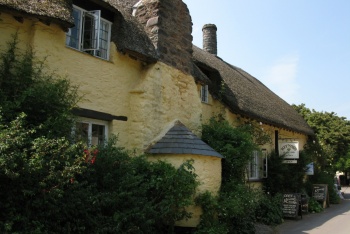
[Main photo: Kitnors Tea Room and Garden in Bossington]
Kitnors Tea Room and Garden
Bossington is a beautiful and popular village by Porlock Bay on the Exmoor coast. Kitnors Tea Room and Garden is a great place to enjoy a cream tea or cake whilst exploring the area.
Location of Kitnors Tea Room and Garden
Kitnors Tea Room and Garden are located in the centre of the village. Bossington Beach, the pebble/shingle ridge and Porlock Bay are a short walk away to the north and north west. Bossington Hill rises to the east. Porlock Ridge and Saltmarsh SSSI/Site of Special Scientific Interest is mainly to the west. Porlock Vale extends inland.
The South West Coat Path passes by Kitnors Tea Room and Garden. The amazing Dunkery and Horner Wood National Nature Reserve rise to the south to Exmoor’s highest point at Dunkery Beacon.
Directions to, and parking at, Kitnors Tea Room and Garden
Follow the A39 to Porlock Vale. Take the turning at Allerford and follow it towards the coast. Bossington village is at the end of the road.
Kitnors Tea Room and Garden is located across the road from the main National Trust car park. Charges apply if you’re not a National Trust member.
Kitnors Tea Room and Garden
Visit Bossington, explore the local area and then enjoy traditional tea, cakes and cream tea in an amazing setting.
We’d recommend wandering down to Bossington Beach or following the South West Coast Path to the top of Bossington Hill for a classic Exmoor view of Porlock Bay, Porlock Vale, the Exmoor coast and the national park’s high moor. Walking the South West Coast Path across Porlock Ridge and Saltmarsh SSSI/Site of Special Scientific Interest to Porlock Weir is also superb.
For a more leisurely trip, wander through the village and photograph Bossington Cottages. The 'lime washed cottages in their cream and brown livery are owned by and maintained by the National Trust. The majority of these, like Kitnors and Tudor Cottage, are late medieval (14th and 15th century), and none are later than 17th century. Built in sandstone and cob and sometimes rendered, many boast a rounded bread oven and a distinctive tall chimney'. (Source: the National Trust Bossington & Coastline Walk leaflet available at the National Trust shop in Selworthy.) Tall chimneys are a feature of the cottages in the villages and hamlets in this part of Exmoor. They were designed to keep sparks away from the thatched roofs. For example, you'll see similar architecture in nearby Allerford and Selworthy.
Bossington village
‘Welcome to Bossington, part of the National Trust’s Holnicote Estate. The village is made up of delightful thatched cottages in the local style. If you walk along the riverside path to the sea, you will discover fantastic views, the wildlife of the salt marshes, and several fascinating reminders of the past.
Reminders of the past. If you walk down the beach, you’ll notice some ruined buildings. They include the remains of several lime kilns. Limestone was brought in by boat from South Wales, then burnt in kilns to produce lime. The lime was used as fertiliser on farmland, and for lime mortar and lime-wash for local buildings. There are also the remains of Second World War pillboxes, built to defend the coastline against invasion. Their position shows how sea levels have risen - they were originally set well back from the shoreline.
Journey’s end for Horner Water. Horner Water rushes through the village on its way to meet the sea at Bossington Beach - the end of its eight mile journey from the highest peak of Exmoor. The river emerges into the sea by filtering through the shingle bank. On this last stretch, watch for brown trout which attract the keen interest of herons.
Sea breach creates wildlife haven. In the past, attempts were made to prevent the sea from breaching the shingle ridge across Porlock Bay. The National Trust and other conservation bodies felt that as our climate changes and sea levels rise, natural processes should be allowed to take place. During a storm in 1996, the sea broke through the ridge and flooded the land beyond. Although it seemed disastrous, a large expanse of saltmarsh has now developed and become a precious habitat.
The marsh is now carpeted with plants such as sea purslane, glasswort, sea aster and yellow horned poppies. Its amazing bird life includes huge flocks of finches and buntings, as well as little egret, curlew, lapwing and oystercatcher.’ (Source: National Trust information board at Bossington.)
Historical and cultural attractions near Kitnors Tea Room and Garden
Allerford Museum West Somerset Rural Life Museum and Victorian School.
Rowbarrows west of Dunkery Beacon. Explore some of Exmoor’s rich prehistory.
Further away, visit:
Minehead Harbour. Harbour in stunning location at the western end of Minehead Beach under North Hill. ‘There has been a harbour at Minehead since the late 1300s.’ (Source: Minehead Harbour website.)
Dunster Castle (National Trust). Impressive National Trust property dominating the beautiful village of Dunster.
Dunster Yarn Market, Butter Cross and Gallox Bridge (English Heritage). English Heritage properties in Dunster.
Cleeve Abbey (English Heritage). Wonderful English Heritage property just east of Exmoor National Park.
The Ancient Mariner Sculpture in Watchet. The Watchet and Quantock Hills National Landscape area inspired Samuel Taylor Coleridge to write ‘The Rime of the Ancient Mariner’.
Coleridge Cottage (National Trust). Visit the cottage in which Coleridge lived and wrote some of his most famous poetry. William Wordsworth lived, briefly, nearby.
Doone Valley/Doone Country. Richard Doddridge Blackmore's famous novel 'Lorna Doone' is set on Exmoor. Roughly speaking, Doone Valley/Doone Country runs south of Malmsmead and Oare along Badgworhty Water. It’s surrounded by high moor. Great walking.
Gardens near Kitnors Tea Room and Garden
Selworthy Green (National Trust). 'There has been a village here since medieval times, but the current cottages were designed by Sir Thomas Dyke Acland in 1828 to create attractive homes for estate pensioners. Beyond the church (14th century), you'll find the village green, surrounded by warm yellow thatched cottages. Notice the tall chimneys which helped to draw the fire and carry sparks away from the thatch.' (Source: information board at Selworthy.)
Further away, visit:
Minehead Blenheim Gardens. Popular gardens behind the Esplanade and North Road at the western end of Minehead Beach.
Dunster Gardens, Dovecote and Tithe Barn. Gardens in the centre of Dunster village.
Dunster Castle (National Trust). The castle is surrounded by many gardens and heavily wooded walkways. The Keep Garden tops the hill on which the castle sits. Lawn’s Bridge, Marshall’s Bridge and Lovers’ Bridge span the River Avill on the eastern side of the castle.
Knightshayes (National Trust). Impressive gardens just off the A396 between Exmoor National Park and Tiverton.
Cothay Manor. Again, gardens outside the national park near Wellington and the M5.
Hestercombe House & Gardens. Gardens located just south of the Quantock Hills National Landscape near Taunton and the M5.
If you don’t mind the drive, RHS Garden Rosemoor by Great Torrington south west of Exmoor National Park is magnificent.
Other attractions near Kitnors Tea Room and Garden
Bossington Beach. Big rock and pebble beach at the eastern end of Porlock Bay.
Porlock Beach. Big rock and pebble beach at the western end of Porlock Bay.
Porlock Ridge and Saltmarsh SSSI/Site of Special Scientific Interest.
Porlock Weir Harbour. Beautiful harbour with pub and hotel.
West Somerset Railway. Heritage railway running between Minehead and Bishops Lydeard.
Dunster Estate (The Crown Estate). Home to England’s tallest tree. Great for walks and views. Wander up to Conygar Tower.
Dunster Beach. Massive low tide sand and stone beach.
Villages and towns near Kitnors Tea Room and Garden
Bossington. Village by Bossington Beach below Bossington Hill.
Allerford village. Beautiful village further inland known for its packhorse bridge.
Selworthy village. One of the West Country’s prettiest villages, Selworthy is famous for its thatched cottages and village green. Enjoy a cream tea at the Periwinkle Tea Room.
Horner village. Another beautiful Exmoor village at the bottom of Horner Wood by Horner Water. Enjoy a cream tea at Horner Tea Gardens.
Luccombe. Village not far from the viewpoint and large car park at Webber’s Post with thatched cottages like those at Selworthy.
Porlock. Famous West Country village in Porlock Vale.
Porlock Weir. Amazing coastal village with harbour, pub, hotel and beach.
Minehead. Popular West Country resort town with huge beach and harbour. The start/end of the South West Coast Path.
Photo Gallery
